Stonehenge Phase 1 – 8300 BCE Documentary

In this video, Robert John Langdon presents mathematical, hydrological, and archaeological evidence that Stonehenge Phase 1—built around 8300 BCE—was Britain’s first true monument. Far older than the conventional 3000 BCE timeline, this reinterpretation reveals a water-filled sanctuary and healing centre, not a dry ceremonial circle. Using LiDAR, ditch profiles, and groundwater modelling, the evidence shows Stonehenge began as a moated medical site in the Mesolithic.

🧮 Key discoveries include: The Aubrey Holes, once thought to be for timber posts, align with water access and wooden palisades. The ditch and moat were dug to the water table, filling naturally and creating bathing pools. Bluestones dissolved minerals into the moat, acting like prehistoric “bath salts” for antiseptic healing. Mortuary slabs within a palisaded enclosure show the site doubled as a treatment centre and mortuary. Radiocarbon reliance on antler picks misdates the site to its abandonment, not its creation.

🔑 Main Arguments: • Stonehenge Phase 1 was a hydrological monument, designed around water, not astronomy. • It functioned as a medical sanctuary, where bluestone-infused waters were used for healing. • The earliest construction aligns with Britain’s high post-glacial water table, not later Neolithic dryland farming.

📏 Methodology Highlights: LiDAR analysis of river valleys and ditch alignments Hydrological modelling of groundwater recession since the Ice Age Archaeological reinterpretation of excavation reports (Aubrey Holes, Station Stones, ditch profiles) Mathematical alignment with Stonehenge’s measured geometry and ditch depth

🚨 This changes everything: Stonehenge did not begin as a late Neolithic temple. It was originally Britain’s first healing monument, built by a Mesolithic boat-using civilisation.

📚 Based on empirical LiDAR, ditch stratigraphy, and hydrological data cross-referenced with archaeological excavation reports.

🔗 LINKS & RESOURCES Blog post: “Stonehenge Phase 1 – Britain’s First Monument” 👉 https://prehistoric-britain.co.uk/sto… Book: The Stonehenge Enigma 👉 https://prehistoric-britain.co.uk/the… 📍 Related Blogs The Stonehenge Code – Mathematical Proof of Early Dating 👉 https://prehistoric-britain.co.uk/the… Post-Glacial Flooding Hypothesis – Rethinking the Past 👉 https://prehistoric-britain.co.uk/ret… Stonehenge, Doggerland & the Atlantis Connection 👉 https://prehistoric-britain.co.uk/sto… Antler Pick Hoax – Misdating Britain’s Monuments 👉 https://prehistoric-britain.co.uk/twi…

Contents/Chapters – with Timestamps

00:00 Stonehenge Phase One — Britain’s First Monument
00:05 Introduction — The Forgotten Phase
01:12 How We Know Stonehenge Phase One Dates to 8300 BCE
03:08 Layout and Function — The Real Purpose of the Site
05:26 The Bluestones — Transport, Composition and Use
07:10 The Water — How It Worked and Why It Mattered
08:25 Evidence of Bluestone Reuse and Replacement
09:43 The Healing Spring at Carn Menyn
13:10 The Palisade and the Silent Towers
14:30 Decline and Transition to Phase Two
15:39 Conclusion — A Monument Built on Function, Not Fantasy

Key Findings

Here are 8 key findings drawn directly from the transcript:

  • Stonehenge Phase One is argued to date to around 8300 BCE, based on radiocarbon dates from Stonehenge postholes and comparable dates from Preseli quarry activity.
  • The earliest Stonehenge is presented as a practical health and mortuary site, not primarily as a temple or ceremonial monument. Its layout is interpreted as combining water, excarnation and controlled access.
  • The ditch is interpreted as a water-filled moat or therapeutic bathing system, supplied by the local chalk aquifer rather than as a purely symbolic earthwork.
  • Bluestones are argued to have been deliberately chipped and placed into the water, allowing salts and trace minerals to leach into the moat and create a mineral-rich treatment environment.
  • The large number of bluestone fragments is interpreted as evidence of repeated use and replacement, rather than simple accidental breakage or collapse.
  • The Preseli spring at Carn Menyn is proposed as a physical model for Stonehenge’s mineral-water system, suggesting that the same stone was transported to reproduce the properties of the Welsh spring.
  • The Y and Z holes are interpreted as evidence for a timber palisade enclosing excarnation platforms, creating a controlled area where scavenger birds could remove flesh before bones were transferred elsewhere.
  • The transition to Phase Two is linked to falling water levels, with the decline of the aquifer-fed system prompting a shift away from the original practical function toward the later monumental Stonehenge.

Transcript

Introduction — The Forgotten Phase

Most people imagine Stonehenge as the great sarsen trilithons. In fact, those belong to Phase Two, constructed around 4300 BCE. The real story begins much earlier.

Phase One, built around 8300 BCE, was entirely different in form and function.

This earliest version of Stonehenge was a working health and mortuary site. It featured a chalk-cut moat that held water, 58 imported Preseli bluestones, and a timber palisade enclosing raised stone platforms for excarnation.

Birds were allowed to clean the dead, a practice still seen today in India’s Towers of Silence. The Y and Z holes marked the outer limits of the palisade. The Q and R holes defined where excarnation slabs once stood.

The entire setup was pragmatic, not ritualistic.

How We Know Stonehenge Phase One Was Built Around 8300 BCE

The date for Stonehenge Phase One is not speculative. It is supported by radiocarbon dating from multiple sites.

Charcoal samples from postholes discovered during the Stonehenge car park excavation have been dated to around 8300 BCE.

This corresponds closely with two quarry sites in the Preseli Hills of Wales, where evidence of human activity, including hearths associated with stone extraction, has also produced C14 dates from the same period.

These sites are not random campfires but appear to be linked directly to quarrying activity associated with the bluestones.

This level of coordination between quarrying and monument construction suggests an advanced society operating across hundreds of miles, capable of planning and logistics long before the Neolithic.

The matched radiocarbon dates from the quarry and monument provide strong empirical support for the theory that bluestones were transported and erected at Stonehenge in the ninth millennium BCE.

Hydrological modelling further reinforces the idea that this was the period when the chalk aquifer could have provided a permanent water source at the monument. But it is the radiocarbon evidence, independently dated at both source and site, that fixes Stonehenge Phase One to approximately 8300 BCE.

This would make it the earliest scientifically verified monumental construction in the British Isles.

Layout and Function — The Real Purpose of the Site

The layout of Phase One was deliberate and practical.

At the centre were the Q and R holes, which supported dolmen-style excarnation slabs: single flat stones balanced precisely on pointed supports to deter rodents.

These slabs were used to expose bodies to the elements and scavenger birds — an efficient and sanitary method of processing the dead.

The palisade surrounding the structure, marked by the Y and Z holes, enclosed this inner space to protect the area while allowing avian access.

The design shows a clear understanding of decomposition cycles and scavenger behaviour.

The north-west orientation of the Q and R hole alignment corresponds to the Moon’s setting position, reinforcing the functional connection between death and timing.

The number of bluestones — 58 — was not arbitrary. It corresponds with a lunar cycle used to track the Moon’s 18.6-year nodal variation and eclipse cycle.

This knowledge was likely vital for excarnation timing, navigation and tidal awareness — critical information for a riverine trading society.

The Bluestones

The bluestones themselves were never intended simply to remain intact.

As noted by Darvill and Wainwright, the bluestones were chipped from almost immediately. More than 3,675 fragments have been discovered — a remarkable total given that only around half of the site has been excavated.

These fragments were deliberately introduced into the chalk moat.

With their mineral and rock-salt content, the bluestone chips enriched the water, enhancing its potential medicinal properties.

This suggests that Stonehenge Phase One was not a ceremonial temple, but a sophisticated facility for managing death, disease and recovery.

Transport, Composition and Use

The Preseli bluestones used at Stonehenge were transported from south-west Wales, likely using river and canal networks rather than being dragged overland.

The discovery of an ancient prehistoric catamaran boatyard in Wales suggests that heavy loads could have been transported using double-hulled craft.

Britain’s river levels were significantly higher at the time, which could have enabled direct water transport towards the site without requiring the type of overland journey normally imagined.

But what matters more than their origin is their composition.

The Preseli stones contain salts, copper and trace minerals that can leach into water when submerged or broken.

More than 3,675 bluestone fragments have been found in the moat area.

This suggests that the stones may have been intentionally broken up to release minerals into the water, creating a form of early mineral spa.

This interpretation is further supported by Darvill and Wainwright, who observed that the stones were being chipped from the time of their erection and proposed that Stonehenge may have served as a healing centre.

This evidence strengthens the argument that Stonehenge functioned primarily as a public-health structure, particularly concerned with sepsis and infection — major causes of death in prehistoric society.

The Water — How It Worked and Why It Mattered

The chalk-cut ditch surrounding the central enclosure was not ornamental.

It was a functional water feature drawing from a naturally high water table during the Mesolithic.

The aquifer-fed ditch would have maintained mineral-rich water around the site, turning the enclosed area into a therapeutic environment.

Bluestone chippings, deliberately broken and deposited in this moat, would have slowly released salts and trace elements into the water.

Salt has antiseptic properties and is still used in wound care today. Soaking injuries in such water could therefore have helped clean wounds and possibly reduce infections in a world without antibiotics.

The antlers found in the ditch have traditionally been interpreted as construction tools.

An alternative explanation is that they were dredging tools used to maintain the flow and clarity of the water system.

They were found in later layers, suggesting periodic cleaning and maintenance of the moat rather than necessarily being tools used in its original excavation.

Evidence of Reuse and Replacement

Conventional narratives tend to portray the stones as being erected once and then remaining in place.

However, C14 dating and excavation records suggest a more complicated history.

The bluestones appear to have been replaced multiple times over a prolonged period, rather than simply being transported once and left standing.

Dating of stone-socket fills indicates repeated insertion events, in some cases separated by centuries.

This supports the idea that the site was actively maintained rather than simply abandoned or commemorated.

Within this model, replacement intervals may have been connected to mineral depletion. Once sufficient salts and trace minerals had leached from existing stones, they could have been broken up and replaced.

This could explain the extraordinarily large number of fragments despite the limited amount of the monument that has been excavated.

With only around 50 per cent of the site dug, more than 3,600 fragments have already been recovered, meaning the total surviving quantity could potentially be considerably greater.

Under this interpretation, these were not simply random breakages or damage caused by collapse. The stones were systematically chipped and the material deposited into the water.

The Healing Spring at Carn Menyn

A major criticism of the healing-stones hypothesis has been the supposed lack of empirical evidence.

But research at Carn Menyn in the Preseli Mountains — one of the proposed source areas for Stonehenge bluestones — reveals a now-dry sacred springhead that may help explain the stones’ original significance.

Gordon Freeman’s fieldwork identified a collapsed cromlech and associated cairn built directly over a once-flowing freshwater spring known locally as Pen y Tarddiant Sanctaidd — the Holy Springhead.

This spring fed a stone-lined stream channel called Rhestr Gerrig, or “Stone Row”, which wound through the landscape towards a marshy area known as Fat Hazelnut Bog.

Although this water source has since dried up, its historical importance appears considerable.

The spring was significant enough to have a formal monument constructed over it, and the fact that a cromlech capped the spring suggests a long tradition of ritualised — and potentially therapeutic — use.

But this may be more than symbolism.

The springhead sits within the geological formation associated with spotted dolerite bluestone.

If the spring water passed through mineral-bearing rock, it could have absorbed salts and trace mineral ions.

The potential effects of mineral water on wounds could have been observed by prehistoric people without any knowledge of modern biochemistry.

This provides a practical reason why the same stone could have been deliberately selected and transported more than 200 kilometres to the chalk aquifer basin at Stonehenge: to reproduce the properties associated with the Preseli water source.

Under this interpretation, the deliberate chipping of bluestones and depositing of their fragments into the moat was not ceremonial destruction.

It was chemical replication.

The stones infused the water with trace minerals, producing a mineralised bathing system intended to reproduce the healing waters associated with the original spring in Wales.

Taken together, the presence of a prehistoric sacred spring, the mineral composition of bluestone and the evidence for deliberately broken bluestone at Stonehenge allow archaeology, geology and hydrology to be considered together as a functional explanation for what has traditionally been labelled a ritual monument.

Stonehenge Phase One was therefore not simply a temple.

It may have been Britain’s first public-health sanctuary, with the spring at Carn Menyn providing its biochemical blueprint.

The Palisade and the Silent Towers

One of the most overlooked features of Stonehenge Phase One is the timber palisade surrounding the inner platforms.

This structure was not necessarily defensive. It could have served a functional and hygienic purpose, containing excarnation within the central area while restricting access.

This enclosure is defined by the Y and Z holes, which are consistent and evenly spaced.

Within this interpretation, they formed the foundation for uprights surrounding a series of protected raised platforms.

Birds — particularly carrion feeders such as jackdaws, ravens and crows — were allowed access to clean the bodies.

The cleaned bones were then taken to nearby Long Barrows for interment.

This practice resembles the principle employed by India’s Towers of Silence, where sky-burial traditions involve exposure of the dead to carrion birds.

It reflects a process of natural decomposition and purification.

Stonehenge’s arrangement therefore provided a sanitary and repeatable method of processing the dead, remarkable for its time.

Decline and Transition to Phase Two

Over time, the water table dropped as the aquifer drained and post-glacial rebound altered the landscape.

The once-functioning moat began drying up and the mineral bath became less effective.

This environmental change marks the end of Phase One and the beginning of a new chapter in the life of Stonehenge.

The bluestones were gradually replaced by larger sarsen stones, marking a transition from a practical medical site to something more monumental.

These sarsens were installed around 4300 BCE, beginning what most people today incorrectly consider to be the start of Stonehenge.

This change is reflected in the construction of the Avenue, a wide route leading away from the original riverfront location towards a new shoreline farther to the north-east.

This redirection reflects both astronomical alignments and the practical reality of hydrological change.

Conclusion — A Monument Built on Function, Not Fantasy

The first phase of Stonehenge was not a mystical temple, a ceremonial gathering place or simply a stone calendar.

It was a public-health structure grounded in the harsh realities of Mesolithic life: infection, injury and death.

Its foundation was not spiritual conjecture but practical science, built on a prehistoric shoreline, maintained by a saturated aquifer and enriched by mineral-laden bluestone chips introduced into the water.

It was a place of triage, treatment and transformation.

Thanks to a new mathematical dating model — grounded in radiocarbon evidence from quarry hearths, site postholes and hydrological mapping — Phase One can be placed at around 8300 BCE.

This would place Stonehenge among the oldest monumental structures in Europe and dismantle the conventional late-Neolithic timeline proposed for its beginnings.

It was not a late-Neolithic curiosity, but a pioneering Mesolithic achievement.

And this was a rational, functional innovation, unlike the speculative calendars and solar temples traditionally proposed.

Archaeologists have consistently struggled to interpret key features of the site.

The postholes forming the central crescent pattern align with where excarnation slabs could have stood. Their unusual shape and placement remain largely unacknowledged in conventional interpretations.

Even the surrounding palisade, indicated in this model by the Y and Z holes, has received little consideration as a protective and hygienic structure.

Traditionally described simply as a ceremonial ditch, the ditch may instead have been a ring of water-filled pits designed to accommodate seating platforms below water level for therapeutic bathing.

This unusual design is central to understanding what Stonehenge might originally have been.

The fog is lifting with advances in LiDAR, mineral analysis, hydrology and radiocarbon calibration.

Stonehenge Phase One should now be considered as a potential candidate for Britain’s first scientific structure — a masterpiece of Mesolithic engineering, biology and community medicine, misunderstood for thousands of years by a profession still reluctant to let go of fantasy.

Author’s Biography
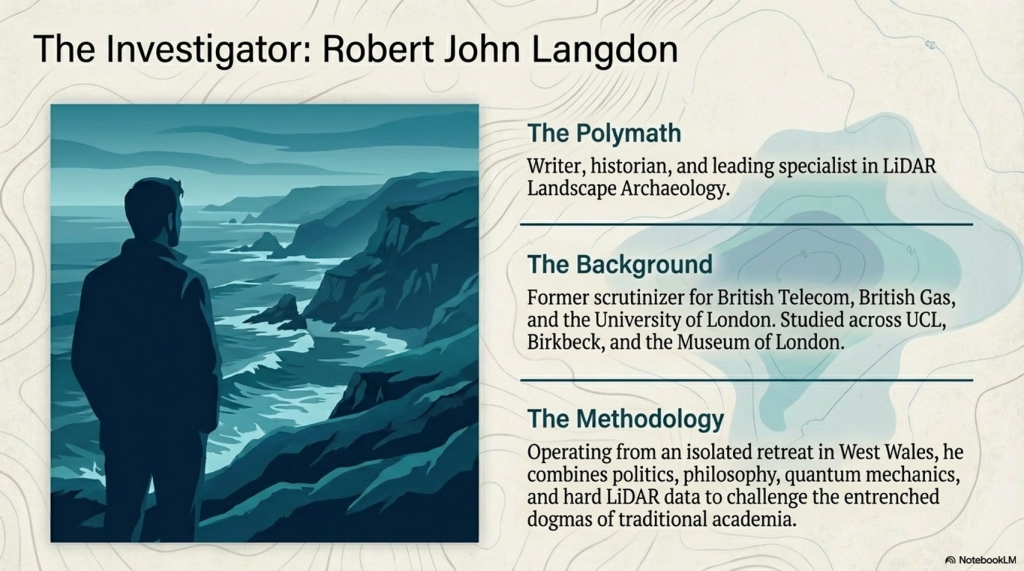
Robert John Langdon, a polymathic luminary, emerges as a writer, historian, and eminent specialist in LiDAR Landscape Archaeology.

His intellectual voyage has been interwoven with stints as an astute scrutineer in government and grand corporate bastions, a tapestry spanning British Telecommunications, Cable and Wireless, British Gas, and the esteemed University of London.

A decade hence, Robert’s transition into retirement unfurled a chapter of insatiable curiosity. This phase saw him immerse himself in Politics, Archaeology, Philosophy, and the enigmatic realm of Quantum Mechanics. His academic odyssey traversed the venerable corridors of knowledge hubs such as the Museum of London, University College London, Birkbeck College, The City Literature Institute, and Chichester University.

In the symphony of his life, Robert is a custodian of three progeny and a pair of cherished grandchildren. His sanctuary lies ensconced in the embrace of West Wales, where he inhabits an isolated cottage, its windows framing a vista of the boundless sea – a retreat from the scrutinising gaze of Her Majesty’s Revenue and Customs, an amiable clandestinity in the lap of nature.

Exploring Prehistoric Britain: A Journey Through Time

My blog delves into the fascinating mysteries of prehistoric Britain, challenging conventional narratives and offering fresh perspectives grounded in cutting-edge research, particularly LiDAR technology. I invite you to explore some key areas of my research. For example, the Wansdyke, often cited as a defensive structure, is re-examined in light of new evidence. I’ve presented my findings in my blog post Wansdyke: A British Frontier Wall – ‘Debunked’, and a Wansdyke LiDAR Flyover video further visualises my conclusions.

My work also often challenges established archaeological dogma. I argue that many sites, such as Hambledon Hill, commonly identified as Iron Age hillforts, are not what they seem. My posts Lidar Investigation Hambledon Hill – NOT an ‘Iron Age Fort’ and Unmasking the “Iron Age Hillfort” Myth explore these ideas in detail and offer an alternative view. Similarly, sites like Cissbury Ring and White Sheet Camp receive re-evaluations based on LiDAR analysis in my posts “Lidar Investigation Cissbury Ring through time” and “Lidar Investigation White Sheet Camp, revealing fascinating insights into their true purpose. I have also examined South Cadbury Castle, often linked to the mythical Camelot.

My research also extends to ancient water management, including the role of canals and other linear earthworks. I have discussed the true origins of Car Dyke in multiple posts, including Car Dyke – ABC News Podcast and Lidar Investigation Car Dyke – North Section, which suggest a Mesolithic origin 2357. I also explore the misidentification of Roman aqueducts, as seen in my posts on the Great Chesters (Roman) Aqueduct. My research has also been greatly informed by my post-glacial flooding hypothesis, which has helped explain landscape transformations over time. I have discussed this hypothesis in several posts, including AI now supports my Post-Glacial Flooding Hypothesis and Exploring Britain’s Flooded Past: A Personal Journey

Finally, my blogs also investigate prehistoric burial practices, as seen in Prehistoric Burial Practices of Britain and explores the mystery of Pillow Mounds, often mistaken for medieval rabbit warrens, but with a potential link to Bronze Age cremation in my posts: Pillow Mounds: A Bronze Age Legacy of Cremation? and The Mystery of Pillow Mounds: Are They Really Medieval Rabbit Warrens?. My research also includes astronomical insights into ancient sites, for example, in Rediscovering the Winter Solstice: The Original Winter Festival. I also review new information about the construction of Stonehenge in The Stonehenge Enigma.

Other Blogs

1

2

8

a

b

c

d

e

f

g

h

i

l

m

n

o

p

r

s

t

u

v

w

TSE DVD Introduction

TSE DVD Introduction to the Documentary ” The Stonehenge Enigma”, showing a trailer of the DVD.

TSE DVD Introduction

Further Reading

For information about British Prehistory, visit www.prehistoric-britain.co.uk for the most extensive archaeology blogs and investigations collection, including modern LiDAR reports.  This site also includes extracts and articles from the Robert John Langdon Trilogy about Britain in the Prehistoric period, including titles such as The Stonehenge Enigma, Dawn of the Lost Civilisation and the ultimate proof of Post Glacial Flooding and the landscape we see today. . (TSE DVD Introduction)

Robert John Langdon has also created a YouTube web channel with over 100 investigations and video documentaries to support his classic trilogy (Prehistoric Britain). He has also released a collection of strange coincidences that he calls ‘13 Things that Don’t Make Sense in History’ and his recent discovery of a lost Stone Avenue at Avebury in Wiltshire called ‘Silbury Avenue – the Lost Stone Avenue’. (TSE DVD Introduction)

Langdon has also produced a series of ‘shorts’, which are extracts from his main body of books:

The Ancient Mariners

Stonehenge Built 8300 BCE

Old Sarum

Prehistoric Rivers

Dykes ditches and Earthworks

Echoes of Atlantis

Homo Superior

For active discussions on the findings of the TRILOGY and recent LiDAR investigations that are published on our WEBSITE, you can join our and leave a message or join the debate on our Facebook Group. . (TSE DVD Introduction)

For in-depth information about British Prehistory, we invite you to explore www.prehistoric-britain.co.uk, an extensive resource featuring archaeology blogs and investigations. This collection includes modern LiDAR reports that shed light on ancient landscapes. Additionally, you will find extracts and articles from the Robert John Langdon Trilogy, offering fascinating insights into Britain during the Prehistoric period. Some notable titles from the trilogy include “The Stonehenge Enigma,” “Dawn of the Lost Civilisation,” and groundbreaking evidence of Post Glacial Flooding and its impact on the landscape we see today.

Robert John Langdon has further enriched the exploration of Prehistoric Britain through his YouTube web channel, boasting over 100 investigations and video documentaries that complement his classic trilogy. In addition to his extensive work, Langdon has unveiled a compilation of intriguing coincidences titled “13 Things that Don’t Make Sense in History.” He has also brought to light his recent discovery of a forgotten Stone Avenue in Avebury, Wiltshire, aptly named ‘Silbury Avenue – the Lost Stone Avenue.’ (TSE DVD Introduction)

For those who wish to actively engage in discussions about the findings from the TRILOGY and recent LiDAR investigations, we invite you to join our community. You can participate by leaving messages and joining debates on our dedicated Facebook Group. We encourage open dialogue and the exchange of ideas to foster a deeper understanding of Prehistoric Britain and its fascinating mysteries.

As you embark on your journey through British Prehistory, we hope these resources provide valuable insights and inspire further exploration of this captivating field of study. . (TSE DVD Introduction)

Unlocking the Mysteries of British Prehistory

Delve into the depths of time, as we embark on a captivating voyage into the enigmatic world of British prehistory. www.prehistoric-britain.co.uk is your portal to a treasure trove of archaeological wonders, modern LiDAR reports, and fascinating insights from the Robert John Langdon Trilogy. This immersive digital hub is your key to unlocking the secrets of Britain’s ancient past.

A Glimpse into the Robert John Langdon Trilogy

Step into the shoes of Robert John Langdon, a dedicated explorer of Britain’s prehistoric mysteries. His trilogy, comprising “The Stonehenge Enigma,” “Dawn of the Lost Civilization,” and “The Post-Glacial Flooding Hypothesis,” is a literary marvel that unravels the untold tales of our ancestors. These books take you on an exhilarating journey through time, meticulously researched and backed by over 125 references from esteemed scientists, archaeological experts, and geological researchers. (TSE DVD Introduction)

Dive into the World of LiDAR

At www.prehistoric-britain.co.uk, we harness the power of LiDAR technology to unearth hidden landscapes and archaeological marvels. Our LiDAR reports offer a modern lens through which you can peer into ancient history. Explore the effects of flooding on the British environment after the great ice age melt, a phenomenon that has shaped the landscape we see today. Join us in decoding the mysteries of our past using cutting-edge technology.

A Multimedia Experience

Our commitment to storytelling extends beyond the written word. Robert John Langdon has curated a rich multimedia experience, including a YouTube web channel featuring over 100 investigations and video documentaries. These visual journeys complement his classic trilogy, providing a multi-dimensional understanding of prehistoric Britain. From Stonehenge’s construction in 8300 BCE to the lost Stone Avenue at Avebury in Wiltshire known as ‘Silbury Avenue,’ these documentaries offer an immersive experience that brings history to life. . (TSE DVD Introduction)

Explore the ’13 Things that Don’t Make Sense in History’

History is replete with anomalies and enigmas that defy explanation. Robert John Langdon has curated a collection of such historical curiosities in ’13 Things that Don’t Make Sense in History.’ These peculiar occurrences and unanswered questions will leave you pondering the mysteries of the past, inviting you to join the debate on their possible interpretations.

A Journey through Short Extracts

For those seeking concise insights, Langdon’s ‘shorts’ provide a glimpse into key topics such as ‘The Ancient Mariners,’ ‘Stonehenge Built 8300 BCE,’ ‘Old Sarum,’ ‘Prehistoric Rivers,’ ‘Dikes, Ditches, and Earthworks,’ ‘Echoes of Atlantis,’ and ‘Homo Superior.’ These bite-sized excerpts from his main body of work offer a quick yet informative overview of fascinating subjects in British prehistory. (TSE DVD Introduction)

Join the Discussion

The quest for knowledge is a communal endeavor. At www.prehistoric-britain.co.uk, we encourage active participation and discussion. Engage with like-minded enthusiasts and scholars to share your thoughts, insights, and questions. Our platform fosters a vibrant community of individuals passionate about uncovering the mysteries of British prehistory. Join the debate, leave a message, and be part of an ongoing exploration into our ancient past.

In conclusion, www.prehistoric-britain.co.uk is your gateway to a world of prehistoric wonders. From the pages of Robert John Langdon’s Trilogy to the visual splendor of LiDAR reports and video documentaries, our platform offers a holistic approach to understanding British prehistory. Explore, engage, and embark on a journey through time like never before. Join us in unraveling the mysteries that shroud our ancient heritage. Visit our website today and become a part of the ongoing adventure into British prehistory.

(TSE DVD Introduction)

TSE DVD – The Post-Glacial Hypothesis

This is the first chapter of the FREE DVD Documentary – TSE DVD – The Post-Glacial Hypothesis

(TSE DVD – The Post-Glacial Hypothesis)

Further Reading

For information about British Prehistory, visit www.prehistoric-britain.co.uk for the most extensive archaeology blogs and investigations collection, including modern LiDAR reports.  This site also includes extracts and articles from the Robert John Langdon Trilogy about Britain in the Prehistoric period, including titles such as The Stonehenge Enigma, Dawn of the Lost Civilisation and the ultimate proof of Post Glacial Flooding and the landscape we see today.

Robert John Langdon has also created a YouTube web channel with over 100 investigations and video documentaries to support his classic trilogy (Prehistoric Britain). He has also released a collection of strange coincidences that he calls ‘13 Things that Don’t Make Sense in History’ and his recent discovery of a lost Stone Avenue at Avebury in Wiltshire called ‘Silbury Avenue – the Lost Stone Avenue’. (TSE DVD – The Post-Glacial Hypothesis)

Langdon has also produced a series of ‘shorts’, which are extracts from his main body of books:

The Ancient Mariners

Stonehenge Built 8300 BCE

Old Sarum

Prehistoric Rivers

Dykes ditches and Earthworks

Echoes of Atlantis

Homo Superior

For active discussions on the findings of the TRILOGY and recent LiDAR investigations that are published on our WEBSITE, you can join our and leave a message or join the debate on our Facebook Group. (TSE DVD – The Post-Glacial Hypothesis)

Further Reading

For in-depth information about British Prehistory, we invite you to explore www.prehistoric-britain.co.uk, an extensive resource featuring archaeology blogs and investigations. This collection includes modern LiDAR reports that shed light on ancient landscapes. Additionally, you will find extracts and articles from the Robert John Langdon Trilogy, offering fascinating insights into Britain during the Prehistoric period. Some notable titles from the trilogy include “The Stonehenge Enigma,” “Dawn of the Lost Civilisation,” and groundbreaking evidence of Post Glacial Flooding and its impact on the landscape we see today.

Robert John Langdon has further enriched the exploration of Prehistoric Britain through his YouTube web channel, boasting over 100 investigations and video documentaries that complement his classic trilogy. In addition to his extensive work, Langdon has unveiled a compilation of intriguing coincidences titled “13 Things that Don’t Make Sense in History.” He has also brought to light his recent discovery of a forgotten Stone Avenue in Avebury, Wiltshire, aptly named ‘Silbury Avenue – the Lost Stone Avenue.’

For those who wish to actively engage in discussions about the findings from the TRILOGY and recent LiDAR investigations, we invite you to join our community. You can participate by leaving messages and joining debates on our dedicated Facebook Group. We encourage open dialogue and the exchange of ideas to foster a deeper understanding of Prehistoric Britain and its fascinating mysteries.

As you embark on your journey through British Prehistory, we hope these resources provide valuable insights and inspire further exploration of this captivating field of study. (TSE DVD – The Post-Glacial Hypothesis)

Unlocking the Mysteries of British Prehistory

Delve into the depths of time, as we embark on a captivating voyage into the enigmatic world of British prehistory. www.prehistoric-britain.co.uk is your portal to a treasure trove of archaeological wonders, modern LiDAR reports, and fascinating insights from the Robert John Langdon Trilogy. This immersive digital hub is your key to unlocking the secrets of Britain’s ancient past.

A Glimpse into the Robert John Langdon Trilogy

Step into the shoes of Robert John Langdon, a dedicated explorer of Britain’s prehistoric mysteries. His trilogy, comprising “The Stonehenge Enigma,” “Dawn of the Lost Civilization,” and “The Post-Glacial Flooding Hypothesis,” is a literary marvel that unravels the untold tales of our ancestors. These books take you on an exhilarating journey through time, meticulously researched and backed by over 125 references from esteemed scientists, archaeological experts, and geological researchers.

Dive into the World of LiDAR

At www.prehistoric-britain.co.uk, we harness the power of LiDAR technology to unearth hidden landscapes and archaeological marvels. Our LiDAR reports offer a modern lens through which you can peer into ancient history. Explore the effects of flooding on the British environment after the great ice age melt, a phenomenon that has shaped the landscape we see today. Join us in decoding the mysteries of our past using cutting-edge technology. (TSE DVD – The Post-Glacial Hypothesis)

A Multimedia Experience

Our commitment to storytelling extends beyond the written word. Robert John Langdon has curated a rich multimedia experience, including a YouTube web channel featuring over 100 investigations and video documentaries. These visual journeys complement his classic trilogy, providing a multi-dimensional understanding of prehistoric Britain. From Stonehenge’s construction in 8300 BCE to the lost Stone Avenue at Avebury in Wiltshire known as ‘Silbury Avenue,’ these documentaries offer an immersive experience that brings history to life.

Explore the ’13 Things that Don’t Make Sense in History’

History is replete with anomalies and enigmas that defy explanation. Robert John Langdon has curated a collection of such historical curiosities in ’13 Things that Don’t Make Sense in History.’ These peculiar occurrences and unanswered questions will leave you pondering the mysteries of the past, inviting you to join the debate on their possible interpretations. (TSE DVD – The Post-Glacial Hypothesis)

A Journey through Short Extracts

For those seeking concise insights, Langdon’s ‘shorts’ provide a glimpse into key topics such as ‘The Ancient Mariners,’ ‘Stonehenge Built 8300 BCE,’ ‘Old Sarum,’ ‘Prehistoric Rivers,’ ‘Dikes, Ditches, and Earthworks,’ ‘Echoes of Atlantis,’ and ‘Homo Superior.’ These bite-sized excerpts from his main body of work offer a quick yet informative overview of fascinating subjects in British prehistory.

Join the Discussion

The quest for knowledge is a communal endeavor. At www.prehistoric-britain.co.uk, we encourage active participation and discussion. Engage with like-minded enthusiasts and scholars to share your thoughts, insights, and questions. Our platform fosters a vibrant community of individuals passionate about uncovering the mysteries of British prehistory. Join the debate, leave a message, and be part of an ongoing exploration into our ancient past.

In conclusion, www.prehistoric-britain.co.uk is your gateway to a world of prehistoric wonders. From the pages of Robert John Langdon’s Trilogy to the visual splendor of LiDAR reports and video documentaries, our platform offers a holistic approach to understanding British prehistory. Explore, engage, and embark on a journey through time like never before. Join us in unraveling the mysteries that shroud our ancient heritage. Visit our website today and become a part of the ongoing adventure into British prehistory.

(TSE DVD – The Post-Glacial Hypothesis)

TSE DVD – Stonehenge Phase I

This is the first chapter of the FREE DVD Documentary – TSE DVD – Stonehenge Phase I

Stonehenge Phase I

Further Reading

For information about British Prehistory, visit www.prehistoric-britain.co.uk for the most extensive archaeology blogs and investigations collection, including modern LiDAR reports.  This site also includes extracts and articles from the Robert John Langdon Trilogy about Britain in the Prehistoric period, including titles such as The Stonehenge Enigma, Dawn of the Lost Civilisation and the ultimate proof of Post Glacial Flooding and the landscape we see today.

Robert John Langdon has also created a YouTube web channel with over 100 investigations and video documentaries to support his classic trilogy (Prehistoric Britain). He has also released a collection of strange coincidences that he calls ‘13 Things that Don’t Make Sense in History’ and his recent discovery of a lost Stone Avenue at Avebury in Wiltshire called ‘Silbury Avenue – the Lost Stone Avenue’. (TSE DVD – Stonehenge Phase I)

Langdon has also produced a series of ‘shorts’, which are extracts from his main body of books:

The Ancient Mariners

Stonehenge Built 8300 BCE

Old Sarum

Prehistoric Rivers

Dykes ditches and Earthworks

Echoes of Atlantis

Homo Superior

For active discussions on the findings of the TRILOGY and recent LiDAR investigations that are published on our WEBSITE, you can join our and leave a message or join the debate on our Facebook Group. (TSE DVD – Stonehenge Phase I)

Further Reading

For in-depth information about British Prehistory, we invite you to explore www.prehistoric-britain.co.uk, an extensive resource featuring archaeology blogs and investigations. This collection includes modern LiDAR reports that shed light on ancient landscapes. Additionally, you will find extracts and articles from the Robert John Langdon Trilogy, offering fascinating insights into Britain during the Prehistoric period. Some notable titles from the trilogy include “The Stonehenge Enigma,” “Dawn of the Lost Civilisation,” and groundbreaking evidence of Post Glacial Flooding and its impact on the landscape we see today.

Robert John Langdon has further enriched the exploration of Prehistoric Britain through his YouTube web channel, boasting over 100 investigations and video documentaries that complement his classic trilogy. In addition to his extensive work, Langdon has unveiled a compilation of intriguing coincidences titled “13 Things that Don’t Make Sense in History.” He has also brought to light his recent discovery of a forgotten Stone Avenue in Avebury, Wiltshire, aptly named ‘Silbury Avenue – the Lost Stone Avenue.’

For those who wish to actively engage in discussions about the findings from the TRILOGY and recent LiDAR investigations, we invite you to join our community. You can participate by leaving messages and joining debates on our dedicated Facebook Group. We encourage open dialogue and the exchange of ideas to foster a deeper understanding of Prehistoric Britain and its fascinating mysteries.

As you embark on your journey through British Prehistory, we hope these resources provide valuable insights and inspire further exploration of this captivating field of study. (TSE DVD – Stonehenge Phase I)

Unlocking the Mysteries of British Prehistory

Delve into the depths of time, as we embark on a captivating voyage into the enigmatic world of British prehistory. www.prehistoric-britain.co.uk is your portal to a treasure trove of archaeological wonders, modern LiDAR reports, and fascinating insights from the Robert John Langdon Trilogy. This immersive digital hub is your key to unlocking the secrets of Britain’s ancient past.

A Glimpse into the Robert John Langdon Trilogy

Step into the shoes of Robert John Langdon, a dedicated explorer of Britain’s prehistoric mysteries. His trilogy, comprising “The Stonehenge Enigma,” “Dawn of the Lost Civilization,” and “The Post-Glacial Flooding Hypothesis,” is a literary marvel that unravels the untold tales of our ancestors. These books take you on an exhilarating journey through time, meticulously researched and backed by over 125 references from esteemed scientists, archaeological experts, and geological researchers.

Dive into the World of LiDAR

At www.prehistoric-britain.co.uk, we harness the power of LiDAR technology to unearth hidden landscapes and archaeological marvels. Our LiDAR reports offer a modern lens through which you can peer into ancient history. Explore the effects of flooding on the British environment after the great ice age melt, a phenomenon that has shaped the landscape we see today. Join us in decoding the mysteries of our past using cutting-edge technology. (TSE DVD – Stonehenge Phase I)

A Multimedia Experience

Our commitment to storytelling extends beyond the written word. Robert John Langdon has curated a rich multimedia experience, including a YouTube web channel featuring over 100 investigations and video documentaries. These visual journeys complement his classic trilogy, providing a multi-dimensional understanding of prehistoric Britain. From Stonehenge’s construction in 8300 BCE to the lost Stone Avenue at Avebury in Wiltshire known as ‘Silbury Avenue,’ these documentaries offer an immersive experience that brings history to life.

Explore the ’13 Things that Don’t Make Sense in History’

History is replete with anomalies and enigmas that defy explanation. Robert John Langdon has curated a collection of such historical curiosities in ’13 Things that Don’t Make Sense in History.’ These peculiar occurrences and unanswered questions will leave you pondering the mysteries of the past, inviting you to join the debate on their possible interpretations. (TSE DVD – Stonehenge Phase I)

A Journey through Short Extracts

For those seeking concise insights, Langdon’s ‘shorts’ provide a glimpse into key topics such as ‘The Ancient Mariners,’ ‘Stonehenge Built 8300 BCE,’ ‘Old Sarum,’ ‘Prehistoric Rivers,’ ‘Dikes, Ditches, and Earthworks,’ ‘Echoes of Atlantis,’ and ‘Homo Superior.’ These bite-sized excerpts from his main body of work offer a quick yet informative overview of fascinating subjects in British prehistory.

Join the Discussion

The quest for knowledge is a communal endeavor. At www.prehistoric-britain.co.uk, we encourage active participation and discussion. Engage with like-minded enthusiasts and scholars to share your thoughts, insights, and questions. Our platform fosters a vibrant community of individuals passionate about uncovering the mysteries of British prehistory. Join the debate, leave a message, and be part of an ongoing exploration into our ancient past.

In conclusion, www.prehistoric-britain.co.uk is your gateway to a world of prehistoric wonders. From the pages of Robert John Langdon’s Trilogy to the visual splendor of LiDAR reports and video documentaries, our platform offers a holistic approach to understanding British prehistory. Explore, engage, and embark on a journey through time like never before. Join us in unraveling the mysteries that shroud our ancient heritage. Visit our website today and become a part of the ongoing adventure into British prehistory.

Stonehenge Phase I

TSE DVD – An Inconvenient Truth

This is the second chapter of the FREE DVD Documentary – TSE DVD An Inconvenient Truth

An Inconvenient Truth

Further Reading

For information about British Prehistory, visit www.prehistoric-britain.co.uk for the most extensive archaeology blogs and investigations collection, including modern LiDAR reports.  This site also includes extracts and articles from the Robert John Langdon Trilogy about Britain in the Prehistoric period, including titles such as The Stonehenge Enigma, Dawn of the Lost Civilisation and the ultimate proof of Post Glacial Flooding and the landscape we see today.

Robert John Langdon has also created a YouTube web channel with over 100 investigations and video documentaries to support his classic trilogy (Prehistoric Britain). He has also released a collection of strange coincidences that he calls ‘13 Things that Don’t Make Sense in History’ and his recent discovery of a lost Stone Avenue at Avebury in Wiltshire called ‘Silbury Avenue – the Lost Stone Avenue’. (TSE DVD – An Inconvenient Truth)

Langdon has also produced a series of ‘shorts’, which are extracts from his main body of books:

The Ancient Mariners

Stonehenge Built 8300 BCE

Old Sarum

Prehistoric Rivers

Dykes ditches and Earthworks

Echoes of Atlantis

Homo Superior

For active discussions on the findings of the TRILOGY and recent LiDAR investigations that are published on our WEBSITE, you can join our and leave a message or join the debate on our Facebook Group. (TSE DVD – An Inconvenient Truth)

Further Reading

For in-depth information about British Prehistory, we invite you to explore www.prehistoric-britain.co.uk, an extensive resource featuring archaeology blogs and investigations. This collection includes modern LiDAR reports that shed light on ancient landscapes. Additionally, you will find extracts and articles from the Robert John Langdon Trilogy, offering fascinating insights into Britain during the Prehistoric period. Some notable titles from the trilogy include “The Stonehenge Enigma,” “Dawn of the Lost Civilisation,” and groundbreaking evidence of Post Glacial Flooding and its impact on the landscape we see today.

Robert John Langdon has further enriched the exploration of Prehistoric Britain through his YouTube web channel, boasting over 100 investigations and video documentaries that complement his classic trilogy. In addition to his extensive work, Langdon has unveiled a compilation of intriguing coincidences titled “13 Things that Don’t Make Sense in History.” He has also brought to light his recent discovery of a forgotten Stone Avenue in Avebury, Wiltshire, aptly named ‘Silbury Avenue – the Lost Stone Avenue.’

For those who wish to actively engage in discussions about the findings from the TRILOGY and recent LiDAR investigations, we invite you to join our community. You can participate by leaving messages and joining debates on our dedicated Facebook Group. We encourage open dialogue and the exchange of ideas to foster a deeper understanding of Prehistoric Britain and its fascinating mysteries.

As you embark on your journey through British Prehistory, we hope these resources provide valuable insights and inspire further exploration of this captivating field of study. (TSE DVD – An Inconvenient Truth)

Unlocking the Mysteries of British Prehistory

Delve into the depths of time, as we embark on a captivating voyage into the enigmatic world of British prehistory. www.prehistoric-britain.co.uk is your portal to a treasure trove of archaeological wonders, modern LiDAR reports, and fascinating insights from the Robert John Langdon Trilogy. This immersive digital hub is your key to unlocking the secrets of Britain’s ancient past.

A Glimpse into the Robert John Langdon Trilogy

Step into the shoes of Robert John Langdon, a dedicated explorer of Britain’s prehistoric mysteries. His trilogy, comprising “The Stonehenge Enigma,” “Dawn of the Lost Civilization,” and “The Post-Glacial Flooding Hypothesis,” is a literary marvel that unravels the untold tales of our ancestors. These books take you on an exhilarating journey through time, meticulously researched and backed by over 125 references from esteemed scientists, archaeological experts, and geological researchers.

Dive into the World of LiDAR

At www.prehistoric-britain.co.uk, we harness the power of LiDAR technology to unearth hidden landscapes and archaeological marvels. Our LiDAR reports offer a modern lens through which you can peer into ancient history. Explore the effects of flooding on the British environment after the great ice age melt, a phenomenon that has shaped the landscape we see today. Join us in decoding the mysteries of our past using cutting-edge technology. (TSE DVD – The Post-Glacial Hypothesis)

A Multimedia Experience

Our commitment to storytelling extends beyond the written word. Robert John Langdon has curated a rich multimedia experience, including a YouTube web channel featuring over 100 investigations and video documentaries. These visual journeys complement his classic trilogy, providing a multi-dimensional understanding of prehistoric Britain. From Stonehenge’s construction in 8300 BCE to the lost Stone Avenue at Avebury in Wiltshire known as ‘Silbury Avenue,’ these documentaries offer an immersive experience that brings history to life.

Explore the ’13 Things that Don’t Make Sense in History’

History is replete with anomalies and enigmas that defy explanation. Robert John Langdon has curated a collection of such historical curiosities in ’13 Things that Don’t Make Sense in History.’ These peculiar occurrences and unanswered questions will leave you pondering the mysteries of the past, inviting you to join the debate on their possible interpretations. (TSE DVD – An Inconvenient Truth)

A Journey through Short Extracts

For those seeking concise insights, Langdon’s ‘shorts’ provide a glimpse into key topics such as ‘The Ancient Mariners,’ ‘Stonehenge Built 8300 BCE,’ ‘Old Sarum,’ ‘Prehistoric Rivers,’ ‘Dikes, Ditches, and Earthworks,’ ‘Echoes of Atlantis,’ and ‘Homo Superior.’ These bite-sized excerpts from his main body of work offer a quick yet informative overview of fascinating subjects in British prehistory.

Join the Discussion

The quest for knowledge is a communal endeavor. At www.prehistoric-britain.co.uk, we encourage active participation and discussion. Engage with like-minded enthusiasts and scholars to share your thoughts, insights, and questions. Our platform fosters a vibrant community of individuals passionate about uncovering the mysteries of British prehistory. Join the debate, leave a message, and be part of an ongoing exploration into our ancient past.

In conclusion, www.prehistoric-britain.co.uk is your gateway to a world of prehistoric wonders. From the pages of Robert John Langdon’s Trilogy to the visual splendor of LiDAR reports and video documentaries, our platform offers a holistic approach to understanding British prehistory. Explore, engage, and embark on a journey through time like never before. Join us in unraveling the mysteries that shroud our ancient heritage. Visit our website today and become a part of the ongoing adventure into British prehistory.

(TSE DVD – An Inconvenient Truth)

TSE DVD – Stonehenge Phase II

This is the third chapter of the FREE DVD Documentary – TSE DVD – Stonehenge Phase II

TSE DVD – Stonehenge Phase II

Further Reading

For information about British Prehistory, visit www.prehistoric-britain.co.uk for the most extensive archaeology blogs and investigations collection, including modern LiDAR reports.  This site also includes extracts and articles from the Robert John Langdon Trilogy about Britain in the Prehistoric period, including titles such as The Stonehenge Enigma, Dawn of the Lost Civilisation and the ultimate proof of Post Glacial Flooding and the landscape we see today.

Robert John Langdon has also created a YouTube web channel with over 100 investigations and video documentaries to support his classic trilogy (Prehistoric Britain). He has also released a collection of strange coincidences that he calls ‘13 Things that Don’t Make Sense in History’ and his recent discovery of a lost Stone Avenue at Avebury in Wiltshire called ‘Silbury Avenue – the Lost Stone Avenue’. (TSE DVD – Stonehenge Phase II)

Langdon has also produced a series of ‘shorts’, which are extracts from his main body of books:

The Ancient Mariners

Stonehenge Built 8300 BCE

Old Sarum

Prehistoric Rivers

Dykes ditches and Earthworks

Echoes of Atlantis

Homo Superior

For active discussions on the findings of the TRILOGY and recent LiDAR investigations that are published on our WEBSITE, you can join our and leave a message or join the debate on our Facebook Group. (TSE DVD – Stonehenge Phase II)

Further Reading

For in-depth information about British Prehistory, we invite you to explore www.prehistoric-britain.co.uk, an extensive resource featuring archaeology blogs and investigations. This collection includes modern LiDAR reports that shed light on ancient landscapes. Additionally, you will find extracts and articles from the Robert John Langdon Trilogy, offering fascinating insights into Britain during the Prehistoric period. Some notable titles from the trilogy include “The Stonehenge Enigma,” “Dawn of the Lost Civilisation,” and groundbreaking evidence of Post Glacial Flooding and its impact on the landscape we see today.

Robert John Langdon has further enriched the exploration of Prehistoric Britain through his YouTube web channel, boasting over 100 investigations and video documentaries that complement his classic trilogy. In addition to his extensive work, Langdon has unveiled a compilation of intriguing coincidences titled “13 Things that Don’t Make Sense in History.” He has also brought to light his recent discovery of a forgotten Stone Avenue in Avebury, Wiltshire, aptly named ‘Silbury Avenue – the Lost Stone Avenue.’

For those who wish to actively engage in discussions about the findings from the TRILOGY and recent LiDAR investigations, we invite you to join our community. You can participate by leaving messages and joining debates on our dedicated Facebook Group. We encourage open dialogue and the exchange of ideas to foster a deeper understanding of Prehistoric Britain and its fascinating mysteries.

As you embark on your journey through British Prehistory, we hope these resources provide valuable insights and inspire further exploration of this captivating field of study. (TSE DVD – Stonehenge Phase II)

Unlocking the Mysteries of British Prehistory

Delve into the depths of time, as we embark on a captivating voyage into the enigmatic world of British prehistory. www.prehistoric-britain.co.uk is your portal to a treasure trove of archaeological wonders, modern LiDAR reports, and fascinating insights from the Robert John Langdon Trilogy. This immersive digital hub is your key to unlocking the secrets of Britain’s ancient past.

A Glimpse into the Robert John Langdon Trilogy

Step into the shoes of Robert John Langdon, a dedicated explorer of Britain’s prehistoric mysteries. His trilogy, comprising “The Stonehenge Enigma,” “Dawn of the Lost Civilization,” and “The Post-Glacial Flooding Hypothesis,” is a literary marvel that unravels the untold tales of our ancestors. These books take you on an exhilarating journey through time, meticulously researched and backed by over 125 references from esteemed scientists, archaeological experts, and geological researchers.

Dive into the World of LiDAR

At www.prehistoric-britain.co.uk, we harness the power of LiDAR technology to unearth hidden landscapes and archaeological marvels. Our LiDAR reports offer a modern lens through which you can peer into ancient history. Explore the effects of flooding on the British environment after the great ice age melt, a phenomenon that has shaped the landscape we see today. Join us in decoding the mysteries of our past using cutting-edge technology. (TSE DVD – The Post-Glacial Hypothesis)

A Multimedia Experience

Our commitment to storytelling extends beyond the written word. Robert John Langdon has curated a rich multimedia experience, including a YouTube web channel featuring over 100 investigations and video documentaries. These visual journeys complement his classic trilogy, providing a multi-dimensional understanding of prehistoric Britain. From Stonehenge’s construction in 8300 BCE to the lost Stone Avenue at Avebury in Wiltshire known as ‘Silbury Avenue,’ these documentaries offer an immersive experience that brings history to life.

Explore the ’13 Things that Don’t Make Sense in History’

History is replete with anomalies and enigmas that defy explanation. Robert John Langdon has curated a collection of such historical curiosities in ’13 Things that Don’t Make Sense in History.’ These peculiar occurrences and unanswered questions will leave you pondering the mysteries of the past, inviting you to join the debate on their possible interpretations. (TSE DVD – Stonehenge Phase II)

A Journey through Short Extracts

For those seeking concise insights, Langdon’s ‘shorts’ provide a glimpse into key topics such as ‘The Ancient Mariners,’ ‘Stonehenge Built 8300 BCE,’ ‘Old Sarum,’ ‘Prehistoric Rivers,’ ‘Dikes, Ditches, and Earthworks,’ ‘Echoes of Atlantis,’ and ‘Homo Superior.’ These bite-sized excerpts from his main body of work offer a quick yet informative overview of fascinating subjects in British prehistory.

Join the Discussion

The quest for knowledge is a communal endeavor. At www.prehistoric-britain.co.uk, we encourage active participation and discussion. Engage with like-minded enthusiasts and scholars to share your thoughts, insights, and questions. Our platform fosters a vibrant community of individuals passionate about uncovering the mysteries of British prehistory. Join the debate, leave a message, and be part of an ongoing exploration into our ancient past.

In conclusion, www.prehistoric-britain.co.uk is your gateway to a world of prehistoric wonders. From the pages of Robert John Langdon’s Trilogy to the visual splendor of LiDAR reports and video documentaries, our platform offers a holistic approach to understanding British prehistory. Explore, engage, and embark on a journey through time like never before. Join us in unraveling the mysteries that shroud our ancient heritage. Visit our website today and become a part of the ongoing adventure into British prehistory.

(TSE DVD – Stonehenge Phase II)

TSE DVD – Durrington Walls & Woodhenge

This is the fourth chapter of the FREE DVD Documentary – TSE DVD – Durrington Walls & Woodhenge

TSE DVD – Durrington Walls & Woodhenge

Further Reading

For information about British Prehistory, visit www.prehistoric-britain.co.uk for the most extensive archaeology blogs and investigations collection, including modern LiDAR reports.  This site also includes extracts and articles from the Robert John Langdon Trilogy about Britain in the Prehistoric period, including titles such as The Stonehenge Enigma, Dawn of the Lost Civilisation and the ultimate proof of Post Glacial Flooding and the landscape we see today.

Robert John Langdon has also created a YouTube web channel with over 100 investigations and video documentaries to support his classic trilogy (Prehistoric Britain). He has also released a collection of strange coincidences that he calls ‘13 Things that Don’t Make Sense in History’ and his recent discovery of a lost Stone Avenue at Avebury in Wiltshire called ‘Silbury Avenue – the Lost Stone Avenue’. (TSE DVD – Durrington Walls & Woodhenge)

Langdon has also produced a series of ‘shorts’, which are extracts from his main body of books:

The Ancient Mariners

Stonehenge Built 8300 BCE

Old Sarum

Prehistoric Rivers

Dykes ditches and Earthworks

Echoes of Atlantis

Homo Superior

For active discussions on the findings of the TRILOGY and recent LiDAR investigations that are published on our WEBSITE, you can join our and leave a message or join the debate on our Facebook Group. (TSE DVD – Durrington Walls & Woodhenge)

Further Reading

For in-depth information about British Prehistory, we invite you to explore www.prehistoric-britain.co.uk, an extensive resource featuring archaeology blogs and investigations. This collection includes modern LiDAR reports that shed light on ancient landscapes. Additionally, you will find extracts and articles from the Robert John Langdon Trilogy, offering fascinating insights into Britain during the Prehistoric period. Some notable titles from the trilogy include “The Stonehenge Enigma,” “Dawn of the Lost Civilisation,” and groundbreaking evidence of Post Glacial Flooding and its impact on the landscape we see today.

Robert John Langdon has further enriched the exploration of Prehistoric Britain through his YouTube web channel, boasting over 100 investigations and video documentaries that complement his classic trilogy. In addition to his extensive work, Langdon has unveiled a compilation of intriguing coincidences titled “13 Things that Don’t Make Sense in History.” He has also brought to light his recent discovery of a forgotten Stone Avenue in Avebury, Wiltshire, aptly named ‘Silbury Avenue – the Lost Stone Avenue.’

For those who wish to actively engage in discussions about the findings from the TRILOGY and recent LiDAR investigations, we invite you to join our community. You can participate by leaving messages and joining debates on our dedicated Facebook Group. We encourage open dialogue and the exchange of ideas to foster a deeper understanding of Prehistoric Britain and its fascinating mysteries.

As you embark on your journey through British Prehistory, we hope these resources provide valuable insights and inspire further exploration of this captivating field of study. (TSE DVD – Durrington Walls & Woodhenge)

Unlocking the Mysteries of British Prehistory

Delve into the depths of time, as we embark on a captivating voyage into the enigmatic world of British prehistory. www.prehistoric-britain.co.uk is your portal to a treasure trove of archaeological wonders, modern LiDAR reports, and fascinating insights from the Robert John Langdon Trilogy. This immersive digital hub is your key to unlocking the secrets of Britain’s ancient past.

A Glimpse into the Robert John Langdon Trilogy

Step into the shoes of Robert John Langdon, a dedicated explorer of Britain’s prehistoric mysteries. His trilogy, comprising “The Stonehenge Enigma,” “Dawn of the Lost Civilization,” and “The Post-Glacial Flooding Hypothesis,” is a literary marvel that unravels the untold tales of our ancestors. These books take you on an exhilarating journey through time, meticulously researched and backed by over 125 references from esteemed scientists, archaeological experts, and geological researchers.

Dive into the World of LiDAR

At www.prehistoric-britain.co.uk, we harness the power of LiDAR technology to unearth hidden landscapes and archaeological marvels. Our LiDAR reports offer a modern lens through which you can peer into ancient history. Explore the effects of flooding on the British environment after the great ice age melt, a phenomenon that has shaped the landscape we see today. Join us in decoding the mysteries of our past using cutting-edge technology. (TSE DVD – Durrington Walls & Woodhenge)

A Multimedia Experience

Our commitment to storytelling extends beyond the written word. Robert John Langdon has curated a rich multimedia experience, including a YouTube web channel featuring over 100 investigations and video documentaries. These visual journeys complement his classic trilogy, providing a multi-dimensional understanding of prehistoric Britain. From Stonehenge’s construction in 8300 BCE to the lost Stone Avenue at Avebury in Wiltshire known as ‘Silbury Avenue,’ these documentaries offer an immersive experience that brings history to life.

Explore the ’13 Things that Don’t Make Sense in History’

History is replete with anomalies and enigmas that defy explanation. Robert John Langdon has curated a collection of such historical curiosities in ’13 Things that Don’t Make Sense in History.’ These peculiar occurrences and unanswered questions will leave you pondering the mysteries of the past, inviting you to join the debate on their possible interpretations. (TSE DVD – Durrington Walls & Woodhenge)

A Journey through Short Extracts

For those seeking concise insights, Langdon’s ‘shorts’ provide a glimpse into key topics such as ‘The Ancient Mariners,’ ‘Stonehenge Built 8300 BCE,’ ‘Old Sarum,’ ‘Prehistoric Rivers,’ ‘Dikes, Ditches, and Earthworks,’ ‘Echoes of Atlantis,’ and ‘Homo Superior.’ These bite-sized excerpts from his main body of work offer a quick yet informative overview of fascinating subjects in British prehistory.

Join the Discussion

The quest for knowledge is a communal endeavor. At www.prehistoric-britain.co.uk, we encourage active participation and discussion. Engage with like-minded enthusiasts and scholars to share your thoughts, insights, and questions. Our platform fosters a vibrant community of individuals passionate about uncovering the mysteries of British prehistory. Join the debate, leave a message, and be part of an ongoing exploration into our ancient past.

In conclusion, www.prehistoric-britain.co.uk is your gateway to a world of prehistoric wonders. From the pages of Robert John Langdon’s Trilogy to the visual splendor of LiDAR reports and video documentaries, our platform offers a holistic approach to understanding British prehistory. Explore, engage, and embark on a journey through time like never before. Join us in unraveling the mysteries that shroud our ancient heritage. Visit our website today and become a part of the ongoing adventure into British prehistory.

(TSE DVD – Durrington Walls & Woodhenge)

TSE DVD Old Sarum

This is the first chapter of the FREE DVD Documentary -TSE DVD Old Sarum

TSE DVD Old Sarum

Further Reading

For information about British Prehistory, visit www.prehistoric-britain.co.uk for the most extensive archaeology blogs and investigations collection, including modern LiDAR reports.  This site also includes extracts and articles from the Robert John Langdon Trilogy about Britain in the Prehistoric period, including titles such as The Stonehenge Enigma, Dawn of the Lost Civilisation and the ultimate proof of Post Glacial Flooding and the landscape we see today.

Robert John Langdon has also created a YouTube web channel with over 100 investigations and video documentaries to support his classic trilogy (Prehistoric Britain). He has also released a collection of strange coincidences that he calls ‘13 Things that Don’t Make Sense in History’ and his recent discovery of a lost Stone Avenue at Avebury in Wiltshire called ‘Silbury Avenue – the Lost Stone Avenue’. (TSE DVD Old Sarum)

Langdon has also produced a series of ‘shorts’, which are extracts from his main body of books:

The Ancient Mariners

Stonehenge Built 8300 BCE

Old Sarum

Prehistoric Rivers

Dykes ditches and Earthworks

Echoes of Atlantis

Homo Superior

For active discussions on the findings of the TRILOGY and recent LiDAR investigations that are published on our WEBSITE, you can join our and leave a message or join the debate on our Facebook Group. (TSE DVD Old Sarum)

Further Reading

For in-depth information about British Prehistory, we invite you to explore www.prehistoric-britain.co.uk, an extensive resource featuring archaeology blogs and investigations. This collection includes modern LiDAR reports that shed light on ancient landscapes. Additionally, you will find extracts and articles from the Robert John Langdon Trilogy, offering fascinating insights into Britain during the Prehistoric period. Some notable titles from the trilogy include “The Stonehenge Enigma,” “Dawn of the Lost Civilisation,” and groundbreaking evidence of Post Glacial Flooding and its impact on the landscape we see today.

Robert John Langdon has further enriched the exploration of Prehistoric Britain through his YouTube web channel, boasting over 100 investigations and video documentaries that complement his classic trilogy. In addition to his extensive work, Langdon has unveiled a compilation of intriguing coincidences titled “13 Things that Don’t Make Sense in History.” He has also brought to light his recent discovery of a forgotten Stone Avenue in Avebury, Wiltshire, aptly named ‘Silbury Avenue – the Lost Stone Avenue.’

For those who wish to actively engage in discussions about the findings from the TRILOGY and recent LiDAR investigations, we invite you to join our community. You can participate by leaving messages and joining debates on our dedicated Facebook Group. We encourage open dialogue and the exchange of ideas to foster a deeper understanding of Prehistoric Britain and its fascinating mysteries.

As you embark on your journey through British Prehistory, we hope these resources provide valuable insights and inspire further exploration of this captivating field of study. (TSE DVD Old Sarum)

Unlocking the Mysteries of British Prehistory

Delve into the depths of time, as we embark on a captivating voyage into the enigmatic world of British prehistory. www.prehistoric-britain.co.uk is your portal to a treasure trove of archaeological wonders, modern LiDAR reports, and fascinating insights from the Robert John Langdon Trilogy. This immersive digital hub is your key to unlocking the secrets of Britain’s ancient past.

A Glimpse into the Robert John Langdon Trilogy

Step into the shoes of Robert John Langdon, a dedicated explorer of Britain’s prehistoric mysteries. His trilogy, comprising “The Stonehenge Enigma,” “Dawn of the Lost Civilization,” and “The Post-Glacial Flooding Hypothesis,” is a literary marvel that unravels the untold tales of our ancestors. These books take you on an exhilarating journey through time, meticulously researched and backed by over 125 references from esteemed scientists, archaeological experts, and geological researchers.

Dive into the World of LiDAR

At www.prehistoric-britain.co.uk, we harness the power of LiDAR technology to unearth hidden landscapes and archaeological marvels. Our LiDAR reports offer a modern lens through which you can peer into ancient history. Explore the effects of flooding on the British environment after the great ice age melt, a phenomenon that has shaped the landscape we see today. Join us in decoding the mysteries of our past using cutting-edge technology. (TSE DVD – The Post-Glacial Hypothesis)

A Multimedia Experience

Our commitment to storytelling extends beyond the written word. Robert John Langdon has curated a rich multimedia experience, including a YouTube web channel featuring over 100 investigations and video documentaries. These visual journeys complement his classic trilogy, providing a multi-dimensional understanding of prehistoric Britain. From Stonehenge’s construction in 8300 BCE to the lost Stone Avenue at Avebury in Wiltshire known as ‘Silbury Avenue,’ these documentaries offer an immersive experience that brings history to life.

Explore the ’13 Things that Don’t Make Sense in History’

History is replete with anomalies and enigmas that defy explanation. Robert John Langdon has curated a collection of such historical curiosities in ’13 Things that Don’t Make Sense in History.’ These peculiar occurrences and unanswered questions will leave you pondering the mysteries of the past, inviting you to join the debate on their possible interpretations. (TSE DVD Old Sarum)

A Journey through Short Extracts

For those seeking concise insights, Langdon’s ‘shorts’ provide a glimpse into key topics such as ‘The Ancient Mariners,’ ‘Stonehenge Built 8300 BCE,’ ‘Old Sarum,’ ‘Prehistoric Rivers,’ ‘Dikes, Ditches, and Earthworks,’ ‘Echoes of Atlantis,’ and ‘Homo Superior.’ These bite-sized excerpts from his main body of work offer a quick yet informative overview of fascinating subjects in British prehistory.

Join the Discussion

The quest for knowledge is a communal endeavor. At www.prehistoric-britain.co.uk, we encourage active participation and discussion. Engage with like-minded enthusiasts and scholars to share your thoughts, insights, and questions. Our platform fosters a vibrant community of individuals passionate about uncovering the mysteries of British prehistory. Join the debate, leave a message, and be part of an ongoing exploration into our ancient past.

In conclusion, www.prehistoric-britain.co.uk is your gateway to a world of prehistoric wonders. From the pages of Robert John Langdon’s Trilogy to the visual splendor of LiDAR reports and video documentaries, our platform offers a holistic approach to understanding British prehistory. Explore, engage, and embark on a journey through time like never before. Join us in unraveling the mysteries that shroud our ancient heritage. Visit our website today and become a part of the ongoing adventure into British prehistory.

(TSE DVD Old Sarum)

TSE DVD – Avebury

This is the first chapter of the FREE DVD Documentary -TSE DVD – Avebury

Further Reading

For information about British Prehistory, visit www.prehistoric-britain.co.uk for the most extensive archaeology blogs and investigations collection, including modern LiDAR reports.  This site also includes extracts and articles from the Robert John Langdon Trilogy about Britain in the Prehistoric period, including titles such as The Stonehenge Enigma, Dawn of the Lost Civilisation and the ultimate proof of Post Glacial Flooding and the landscape we see today. . (TSE DVD Introduction)

Robert John Langdon has also created a YouTube web channel with over 100 investigations and video documentaries to support his classic trilogy (Prehistoric Britain). He has also released a collection of strange coincidences that he calls ‘13 Things that Don’t Make Sense in History’ and his recent discovery of a lost Stone Avenue at Avebury in Wiltshire called ‘Silbury Avenue – the Lost Stone Avenue’. (TSE DVD – Avebury)

Langdon has also produced a series of ‘shorts’, which are extracts from his main body of books:

The Ancient Mariners

Stonehenge Built 8300 BCE

Old Sarum

Prehistoric Rivers

Dykes ditches and Earthworks

Echoes of Atlantis

Homo Superior

For active discussions on the findings of the TRILOGY and recent LiDAR investigations that are published on our WEBSITE, you can join our and leave a message or join the debate on our Facebook Group. . (TSE DVD – Avebury)

For in-depth information about British Prehistory, we invite you to explore www.prehistoric-britain.co.uk, an extensive resource featuring archaeology blogs and investigations. This collection includes modern LiDAR reports that shed light on ancient landscapes. Additionally, you will find extracts and articles from the Robert John Langdon Trilogy, offering fascinating insights into Britain during the Prehistoric period. Some notable titles from the trilogy include “The Stonehenge Enigma,” “Dawn of the Lost Civilisation,” and groundbreaking evidence of Post Glacial Flooding and its impact on the landscape we see today.

Robert John Langdon has further enriched the exploration of Prehistoric Britain through his YouTube web channel, boasting over 100 investigations and video documentaries that complement his classic trilogy. In addition to his extensive work, Langdon has unveiled a compilation of intriguing coincidences titled “13 Things that Don’t Make Sense in History.” He has also brought to light his recent discovery of a forgotten Stone Avenue in Avebury, Wiltshire, aptly named ‘Silbury Avenue – the Lost Stone Avenue.’ (TSE DVD – Avebury)

For those who wish to actively engage in discussions about the findings from the TRILOGY and recent LiDAR investigations, we invite you to join our community. You can participate by leaving messages and joining debates on our dedicated Facebook Group. We encourage open dialogue and the exchange of ideas to foster a deeper understanding of Prehistoric Britain and its fascinating mysteries. (TSE DVD – Avebury)

As you embark on your journey through British Prehistory, we hope these resources provide valuable insights and inspire further exploration of this captivating field of study. . (TSE DVD – Avebury)

Unlocking the Mysteries of British Prehistory

Delve into the depths of time, as we embark on a captivating voyage into the enigmatic world of British prehistory. www.prehistoric-britain.co.uk is your portal to a treasure trove of archaeological wonders, modern LiDAR reports, and fascinating insights from the Robert John Langdon Trilogy. This immersive digital hub is your key to unlocking the secrets of Britain’s ancient past.

A Glimpse into the Robert John Langdon Trilogy

Step into the shoes of Robert John Langdon, a dedicated explorer of Britain’s prehistoric mysteries. His trilogy, comprising “The Stonehenge Enigma,” “Dawn of the Lost Civilization,” and “The Post-Glacial Flooding Hypothesis,” is a literary marvel that unravels the untold tales of our ancestors. These books take you on an exhilarating journey through time, meticulously researched and backed by over 125 references from esteemed scientists, archaeological experts, and geological researchers. (TSE DVD Introduction)

Dive into the World of LiDAR

At www.prehistoric-britain.co.uk, we harness the power of LiDAR technology to unearth hidden landscapes and archaeological marvels. Our LiDAR reports offer a modern lens through which you can peer into ancient history. Explore the effects of flooding on the British environment after the great ice age melt, a phenomenon that has shaped the landscape we see today. Join us in decoding the mysteries of our past using cutting-edge technology.

A Multimedia Experience

Our commitment to storytelling extends beyond the written word. Robert John Langdon has curated a rich multimedia experience, including a YouTube web channel featuring over 100 investigations and video documentaries. These visual journeys complement his classic trilogy, providing a multi-dimensional understanding of prehistoric Britain. From Stonehenge’s construction in 8300 BCE to the lost Stone Avenue at Avebury in Wiltshire known as ‘Silbury Avenue,’ these documentaries offer an immersive experience that brings history to life. . (TSE DVD – Avebury)

Explore the ’13 Things that Don’t Make Sense in History’

History is replete with anomalies and enigmas that defy explanation. Robert John Langdon has curated a collection of such historical curiosities in ’13 Things that Don’t Make Sense in History.’ These peculiar occurrences and unanswered questions will leave you pondering the mysteries of the past, inviting you to join the debate on their possible interpretations.

A Journey through Short Extracts

For those seeking concise insights, Langdon’s ‘shorts’ provide a glimpse into key topics such as ‘The Ancient Mariners,’ ‘Stonehenge Built 8300 BCE,’ ‘Old Sarum,’ ‘Prehistoric Rivers,’ ‘Dikes, Ditches, and Earthworks,’ ‘Echoes of Atlantis,’ and ‘Homo Superior.’ These bite-sized excerpts from his main body of work offer a quick yet informative overview of fascinating subjects in British prehistory. (TSE DVD – Avebury)

Join the Discussion

The quest for knowledge is a communal endeavor. At www.prehistoric-britain.co.uk, we encourage active participation and discussion. Engage with like-minded enthusiasts and scholars to share your thoughts, insights, and questions. Our platform fosters a vibrant community of individuals passionate about uncovering the mysteries of British prehistory. Join the debate, leave a message, and be part of an ongoing exploration into our ancient past.

In conclusion, www.prehistoric-britain.co.uk is your gateway to a world of prehistoric wonders. From the pages of Robert John Langdon’s Trilogy to the visual splendor of LiDAR reports and video documentaries, our platform offers a holistic approach to understanding British prehistory. Explore, engage, and embark on a journey through time like never before. Join us in unraveling the mysteries that shroud our ancient heritage. Visit our website today and become a part of the ongoing adventure into British prehistory.

(TSE DVD – Avebury)

TSE DVD – Antler Picks

TSE DVD Introduction to the Documentary – TSE DVD – Antler Picks

Further Reading

For information about British Prehistory, visit www.prehistoric-britain.co.uk for the most extensive archaeology blogs and investigations collection, including modern LiDAR reports.  This site also includes extracts and articles from the Robert John Langdon Trilogy about Britain in the Prehistoric period, including titles such as The Stonehenge Enigma, Dawn of the Lost Civilisation and the ultimate proof of Post Glacial Flooding and the landscape we see today. .(TSE DVD – Antler Picks)

Robert John Langdon has also created a YouTube web channel with over 100 investigations and video documentaries to support his classic trilogy (Prehistoric Britain). He has also released a collection of strange coincidences that he calls ‘13 Things that Don’t Make Sense in History’ and his recent discovery of a lost Stone Avenue at Avebury in Wiltshire called ‘Silbury Avenue – the Lost Stone Avenue’. (TSE DVD – Antler Picks)

Langdon has also produced a series of ‘shorts’, which are extracts from his main body of books:

The Ancient Mariners

Stonehenge Built 8300 BCE

Old Sarum

Prehistoric Rivers

Dykes ditches and Earthworks

Echoes of Atlantis

Homo Superior

For active discussions on the findings of the TRILOGY and recent LiDAR investigations that are published on our WEBSITE, you can join our and leave a message or join the debate on our Facebook Group. .(TSE DVD – Antler Picks)

For in-depth information about British Prehistory, we invite you to explore www.prehistoric-britain.co.uk, an extensive resource featuring archaeology blogs and investigations. This collection includes modern LiDAR reports that shed light on ancient landscapes. Additionally, you will find extracts and articles from the Robert John Langdon Trilogy, offering fascinating insights into Britain during the Prehistoric period. Some notable titles from the trilogy include “The Stonehenge Enigma,” “Dawn of the Lost Civilisation,” and groundbreaking evidence of Post Glacial Flooding and its impact on the landscape we see today.

Robert John Langdon has further enriched the exploration of Prehistoric Britain through his YouTube web channel, boasting over 100 investigations and video documentaries that complement his classic trilogy. In addition to his extensive work, Langdon has unveiled a compilation of intriguing coincidences titled “13 Things that Don’t Make Sense in History.” He has also brought to light his recent discovery of a forgotten Stone Avenue in Avebury, Wiltshire, aptly named ‘Silbury Avenue – the Lost Stone Avenue.'(TSE DVD – Antler Picks)

For those who wish to actively engage in discussions about the findings from the TRILOGY and recent LiDAR investigations, we invite you to join our community. You can participate by leaving messages and joining debates on our dedicated Facebook Group. We encourage open dialogue and the exchange of ideas to foster a deeper understanding of Prehistoric Britain and its fascinating mysteries.(TSE DVD – Antler Picks)

As you embark on your journey through British Prehistory, we hope these resources provide valuable insights and inspire further exploration of this captivating field of study.(TSE DVD – Antler Picks)

Unlocking the Mysteries of British Prehistory

Delve into the depths of time, as we embark on a captivating voyage into the enigmatic world of British prehistory. www.prehistoric-britain.co.uk is your portal to a treasure trove of archaeological wonders, modern LiDAR reports, and fascinating insights from the Robert John Langdon Trilogy. This immersive digital hub is your key to unlocking the secrets of Britain’s ancient past.

A Glimpse into the Robert John Langdon Trilogy

Step into the shoes of Robert John Langdon, a dedicated explorer of Britain’s prehistoric mysteries. His trilogy, comprising “The Stonehenge Enigma,” “Dawn of the Lost Civilization,” and “The Post-Glacial Flooding Hypothesis,” is a literary marvel that unravels the untold tales of our ancestors. These books take you on an exhilarating journey through time, meticulously researched and backed by over 125 references from esteemed scientists, archaeological experts, and geological researchers. (TSE DVD – Antler Picks)

Dive into the World of LiDAR

At www.prehistoric-britain.co.uk, we harness the power of LiDAR technology to unearth hidden landscapes and archaeological marvels. Our LiDAR reports offer a modern lens through which you can peer into ancient history. Explore the effects of flooding on the British environment after the great ice age melt, a phenomenon that has shaped the landscape we see today. Join us in decoding the mysteries of our past using cutting-edge technology.

A Multimedia Experience

Our commitment to storytelling extends beyond the written word. Robert John Langdon has curated a rich multimedia experience, including a YouTube web channel featuring over 100 investigations and video documentaries. These visual journeys complement his classic trilogy, providing a multi-dimensional understanding of prehistoric Britain. From Stonehenge’s construction in 8300 BCE to the lost Stone Avenue at Avebury in Wiltshire known as ‘Silbury Avenue,’ these documentaries offer an immersive experience that brings history to life. . (TSE DVD – Antler Picks)

Explore the ’13 Things that Don’t Make Sense in History’

History is replete with anomalies and enigmas that defy explanation. Robert John Langdon has curated a collection of such historical curiosities in ’13 Things that Don’t Make Sense in History.’ These peculiar occurrences and unanswered questions will leave you pondering the mysteries of the past, inviting you to join the debate on their possible interpretations.

A Journey through Short Extracts

For those seeking concise insights, Langdon’s ‘shorts’ provide a glimpse into key topics such as ‘The Ancient Mariners,’ ‘Stonehenge Built 8300 BCE,’ ‘Old Sarum,’ ‘Prehistoric Rivers,’ ‘Dikes, Ditches, and Earthworks,’ ‘Echoes of Atlantis,’ and ‘Homo Superior.’ These bite-sized excerpts from his main body of work offer a quick yet informative overview of fascinating subjects in British prehistory.(TSE DVD – Antler Picks)

Join the Discussion

The quest for knowledge is a communal endeavor. At www.prehistoric-britain.co.uk, we encourage active participation and discussion. Engage with like-minded enthusiasts and scholars to share your thoughts, insights, and questions. Our platform fosters a vibrant community of individuals passionate about uncovering the mysteries of British prehistory. Join the debate, leave a message, and be part of an ongoing exploration into our ancient past.

In conclusion, www.prehistoric-britain.co.uk is your gateway to a world of prehistoric wonders. From the pages of Robert John Langdon’s Trilogy to the visual splendor of LiDAR reports and video documentaries, our platform offers a holistic approach to understanding British prehistory. Explore, engage, and embark on a journey through time like never before. Join us in unraveling the mysteries that shroud our ancient heritage. Visit our website today and become a part of the ongoing adventure into British prehistory.

(TSE DVD – Antler Picks)